
Recently, CIRS Testing and Amway (Shanghai) Technology Development Co., Ltd. (hereinafter referred to as "Amway") achieved a significant breakthrough in their collaborative research on the Evaluation Method for the Repair Efficacy of Hair Products against Chemical Damage. The related findings have been officially published in the domestic core journal China Surfactant Detergent & Cosmetics. This research provides a novel scientific tool for evaluating the repair efficacy of hair products targeting chemical damage, based on three dimensions: microscopic imaging, physical properties, and chemical composition.
As a leading third-party testing institution in China, CIRS Testing focused on cutting-edge technology research and development in the cosmetics and personal care products sector, accumulating substantial technical expertise, particularly in the field of hair product efficacy evaluation. Amway, a globally renowned health and wellness company, is dedicated to the long-term research and development of safe and effective personal care products and maintains a continuous commitment to scientific innovation in hair care. Driven by shared scientific principles and technological pursuits, the two parties established a cooperation project on the "Evaluation Method for the Repair Efficacy of Hair Products against Chemical Damage."
The jointly developed evaluation method has achieved three core technological and methodological innovations:
1. Analysis of Void Area Proportion in Hair Fiber Cross-Sections: This allows for the direct visualization of a hair product's repair efficacy against chemical damage.
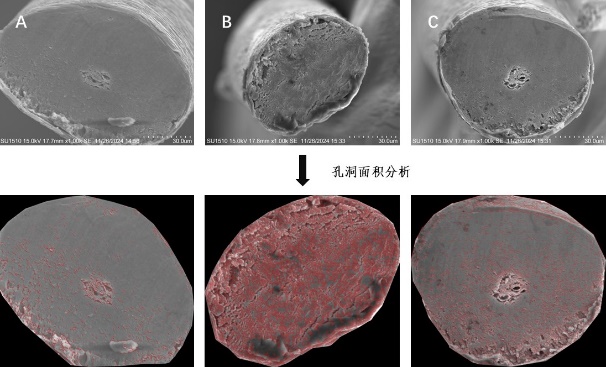
Figure 1: State of hair fiber cross-sections (Figure A: Healthy hair bundle, Figure B: Damaged hair bundle, Figure C: Tested hair bundle)
2. In-house Developed LC-MS/MS Testing Method for Hair Cysteine Content: This method accurately presents the degree of chemical damage to hair and the effects of repair. Compared to traditional methods, it offers higher sensitivity, greater operability, and improved accuracy of results.
3. Fluorescence Staining of Cysteine in Hair Cross-Sections: This provides an intuitive display of cysteine distribution across the hair cross-section, serving as a visual indicator for evaluating the repair efficacy against chemical damage.
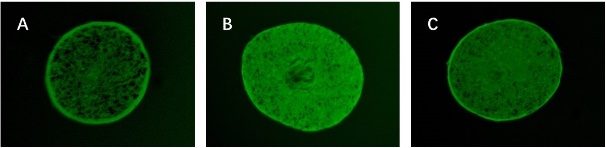
Figure 2: Cysteine distribution in hair fiber cross-sections (Figure A: Healthy hair bundle, Figure B: Damaged hair bundle, Figure C: Tested hair bundle)
Furthermore, in the field of hair efficacy evaluation, CIRS Testing has constructed six models simulating different damage scenarios (covering high temperature, chemical, physical, air pollution, UV radiation, and seawater/swimming pool water damage). By deeply integrating these with three core testing dimensions—physical property, chemical composition, and microscopic imaging —CIRS Testing has developed a comprehensive efficacy evaluation capability using real hair in vitro. This system establishes a systematic and precise framework for hair efficacy evaluation from a fundamental scientific perspective. It not only enables the scientific simulation and quantitative assessment of various hair damage scenarios but also provides clients with full-chain scientific support—from product development to market launch—by leveraging a global perspective and multi-dimensional technological integration. This approach propels hair efficacy evaluation into an era of data-driven precision and injects core momentum into the upgrading and standardization of industry practices.
If you need any assistance or have any questions, please get in touch with us via service@cirs-group.com.
 Contact Us
 Quick Navigation